I think we’ve forgotten what jewellery actually is.
We nowadays talk about jewellery like it’s merely a product.
How many carats? What metal?
How much does it cost?
Is it natural?
Is it certified?
What’s the resale value on this or that piece?
And obviously, those things matter to some degree, we offer verified certificates with our legacy pieces. We’re not pretending they don’t. Materials cost money. Craftsmanship costs money. A good piece of jewellery can be an incredibly valuable object because of the intense detail and precision.
But really that’s not where jewellery started.
Long before jewellery became luxury, it was ‘human’.
Someone picked something up.
A shell maybe
or stone,
A piece of bone and even metal.
And they looked at it differently from everything else around them.
They worked it.
Drilled it. Shaped it.
They put it against their body.
And somehow, that object strangely became part of them. and they themselves couldn’t quite yet explain why it had that deep sense feeling. All we know is that feeling carried along in our DNA to today.
That feeling is where jewellery begins.
Not with price, with meaning.
The first jewellery wasn’t expensive
Some of the oldest known personal ornaments in the archaeological record are incredibly simple.
Shells.
That’s it.
At Bizmoune Cave in Morocco, archaeologists found marine shell beads dating to at least around 142,000 years ago. The research describes these ornaments as among the earliest evidence of symbolic behavior and suggests they may have functioned as signals of identity.
Then there are the famous shell beads from Blombos Cave all the way here in South Africa.
Around 75,000 years old.
Forty-one marine shells with intentional perforations and evidence consistent with them being used as beads.
And this is the part that actually gets me.
There was no jewellery counter.
There was no Tiffany.
There was no Cartier.
There was no price tag.
Nobody was standing there asking whether the shell had a good resale value.
Somebody just decided:
I want to carry this with me.
And we don’t know exactly what every bead meant to the person who wore it. Archaeology can give us evidence of symbolic behaviour, identity and social communication, but it can’t give us a direct transcript of someone’s thoughts 75,000 years ago.
Still, the idea is difficult to ignore.
Humans have been taking things from the world around us and turning them into symbols for an incredibly long time.
That’s jewellery for ya.
Maybe jewellery was one of our first ways of saying who we are
Before we had Instagram bios.
Before our corporate logos.
Before business cards.
Before uniforms.
Before most of the things we now use to communicate identity..
we had ‘objects’.
Something worn around your neck.
Something around your wrist.
Something in your hair, your clothing.
Or something passed down through your family.
And suddenly, something about you was , ‘visible’
Maybe it said where you belonged or maybe it said what you had achieved.
And in some instances said what you believed.
Maybe it represented a deeper connected you, it protected you.
Maybe it marked a transformative transition in your life.
We can’t actually always know exactly what every ancient piece meant.
But we do know jewellery has repeatedly been used across human societies as a way of expressing identity, social position, ritual and belonging.
Which means something quite important.
Jewellery has never really just been decoration.
We’ve always been using it to say things that are difficult to say with words.
Gold wasn’t always about being rich
Today, gold is almost automatically associated with money.
Luxury.
Success.
Status.
But that isn’t the whole story.
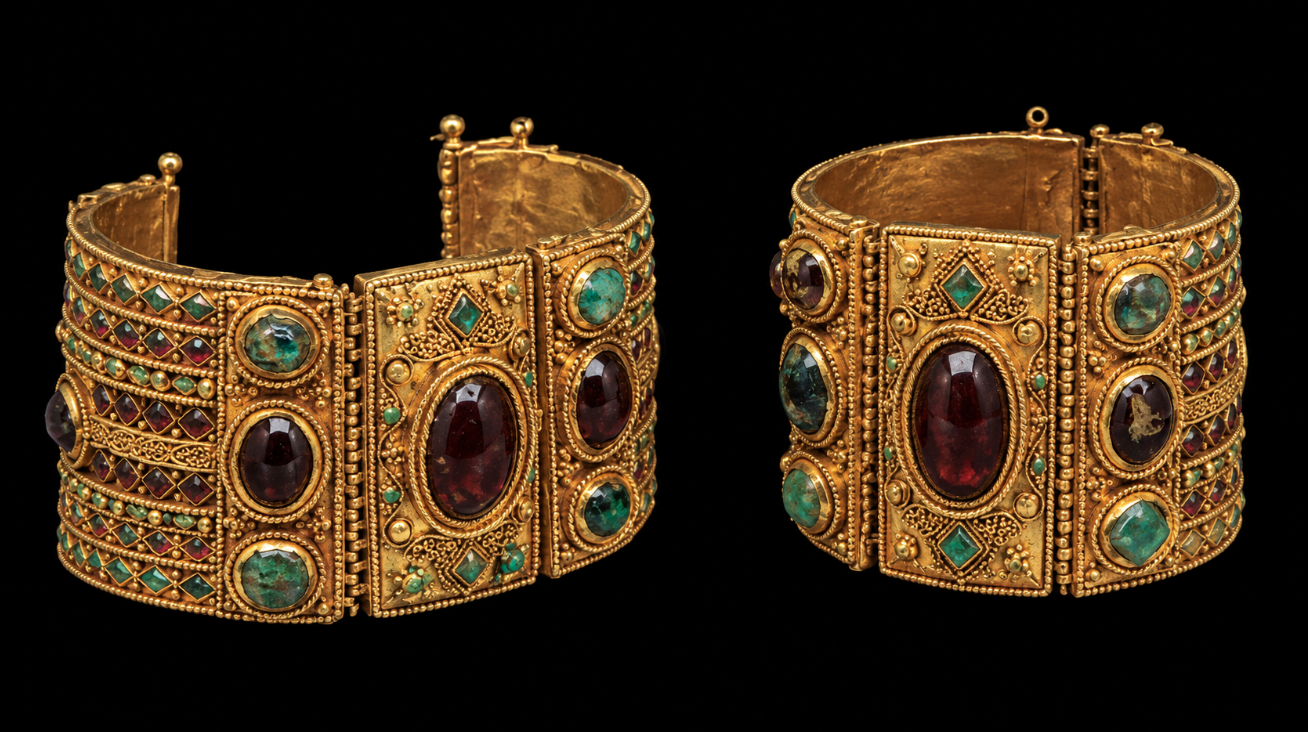
Ancient Egyptians gave gold an enormous amount of symbolic importance. Gold was connected with the divine, the sun and ideas surrounding permanence and the afterlife. Jewellery could be part of the protection and transformation of the dead as they entered another existence.
So when an ancient Egyptian wore gold, the meaning could be much bigger than:
I’m wealthy.
It could be:
I want to carry something that represents permanence.
Something that doesn’t behave like ordinary materials.
Something that shines.
Something associated with the sun.
Something that can accompany a person beyond ordinary life.
That’s a completely different relationship with material.
And that’s something I think modern jewellery sometimes loses.
We reduce the material to its price.
9K.
14K.
18K.
24K.
And obviously, those differences matter technically.
But there is another question we should be asking.
What does the person want the material to say?
Maybe gold represents warmth.
Maybe it represents legacy.
Maybe it represents a family tradition.
Maybe it represents finally reaching a point in life where the person can give themselves something they couldn’t afford before.
Maybe it represents someone who has always wanted a gold ring because that’s what their mother wore.
The material isn’t the story.
It’s part of the language.
⸻
Silver feels different
Silver has always had its own personality.
Even visually.
Gold catches the eye with warmth.
Silver reflects light differently.
It feels cooler.
Quieter.
Cleaner.
In ancient Egypt, silver was associated with the moon, ritual purity and the bones of the gods. Interestingly, silver was also scarce in Egypt and could at certain points be valued more highly than gold.
So again, the modern idea that gold automatically means “more valuable” doesn’t really explain history.
Value has always depended on context.
Availability.
Culture.
Belief.
Meaning.
And the same thing happens today.
Somebody can have the money to buy an expensive gold piece and still choose silver.
Not because they couldn’t afford gold.
Because silver feels more like them.
That distinction matters.
At Soulmate Sparkles, we’re interested in that distinction.
Copper, steel, and the materials we don’t usually romanticise
Copper is interesting because it reminds us that jewellery doesn’t have to begin with a precious metal.
Copper was part of humanity’s development of metallurgy and was used across many cultures for objects of adornment as well as practical purposes.
And then, much later, we have materials like stainless steel.
Modern.
Industrial.
Strong.
Practical.
Sometimes people hear “stainless steel jewellery” and immediately think:
That’s the cheap stuff.
I don’t really agree with that way of thinking.
A material isn’t emotionally inferior because it costs less.
Imagine someone who has spent the last five years rebuilding their life.
They don’t want something delicate.
They want something that feels strong.
Something that doesn’t need to shout.
Something that says:
I’ve been through things and I’m still here.
For that person, stainless steel could actually make more sense than a traditional precious metal.
That’s the point.
Jewellery shouldn’t be selected purely by a hierarchy of prices.
It should be selected by a hierarchy of meaning.
And then humanity found diamonds
Diamonds are fascinating because they’ve accumulated so much meaning around them.
They’ve been known in India for more than 3,000 years, and India was an important early source of diamonds. Ancient traditions gave diamonds associations with power, protection and social position, while later Western traditions developed their own mythology around the stone.
And physically, diamonds are extraordinary.
They form deep inside the Earth under immense pressure and temperature, with natural diamonds dating from millions to billions of years old.
So it’s easy to understand why humans looked at them and created stories around them.
Something formed under pressure.
Something that survived.
Something incredibly hard.
Something that can remain for generations.
That makes an obvious metaphor for love.
We went through pressure and we’re still here.
But this is where Soulmate Sparkles takes a different position.
Because there’s something else we have to ask.
What did it take to get this stone here?
We don’t want ignorance to be part of the story
This is something we’ve had to think about seriously.
The jewellery industry has spent a long time selling people the idea that the more rare, expensive and naturally extracted something is, the more meaningful it becomes.
But that’s not automatically true.
A natural diamond can have an extraordinary geological history.
It can be billions of years old.
That’s objectively fascinating.
But geological age isn’t the only history a stone has.
There is also the human history.
The history of where it was extracted.
Who extracted it.
How it was extracted.
Who benefited.
Who didn’t.
What communities were affected.
What environmental and social questions surrounded its journey.
The diamond industry has made significant changes over time, including traceability initiatives and systems such as the Kimberley Process, which was created to address the trade in rough diamonds associated with conflict. But the existence of systems designed to address these problems is itself a reminder that the history of diamonds isn’t only geological. It is also human.
And for us, that matters.
Because imagine giving somebody a ring and saying:
This represents love, commitment, compassion and the future.
But you’ve deliberately chosen not to think about the human story attached to the material because the stone looks beautiful.
That doesn’t sit right with us.
We don’t want ignorance to be part of the meaning.
We don’t want to celebrate a symbol of love while pretending the wider world doesn’t exist.
We don’t want luxury to require us to look away.
So Soulmate Sparkles has made a conscious choice.
We don’t build our jewellery around mined diamonds.
That doesn’t mean we hate diamonds
Quite the opposite.
We love diamonds.
We love what they are.
The material.
The brilliance.
The hardness.
The way light moves through a well-cut stone.
The history of diamond itself is incredible.
What we question is the assumption that natural automatically means more meaningful.
It doesn’t.
A natural diamond and a laboratory-grown diamond have different origins.
That’s a fact.
A natural diamond forms through geological processes deep within the Earth.
A laboratory-grown diamond is created through a technological process, commonly HPHT or CVD.
But chemically, structurally and physically, lab-grown diamonds are essentially the same material as natural diamonds. They’re real diamonds, not diamond imitations.
So the question becomes much more interesting.
If the meaning of a diamond is supposed to be love…
why should the meaning depend on whether nature made it or a human being used technology to recreate the conditions under which diamond grows?
For some people, the geological story will matter.
For us, the human story matters too.
And we would rather create a piece that represents love without asking the customer to ignore everything outside the jewellery box.
Maybe the story of the lab-grown diamond is actually a very modern one
There’s something poetic about it.
For thousands of years, humans looked at the natural world and wondered how to reproduce what they saw.
Then eventually, we learned enough about materials science to create diamond ourselves.
Pressure.
Temperature.
Carbon.
Technology.
Human ingenuity.
A material once associated almost entirely with geological time can now also be part of a story about human innovation.
And that doesn’t make the stone less real.
It just gives it a different story.
At Soulmate Sparkles, that story can be:
We didn’t need to take something from the Earth for this symbol of our love to exist.
For someone else, it could be:
We chose something created through science because that represents the future we’re building together.
And somebody else might simply say:
I love how this diamond looks.
That’s fine too.
We don’t need to manufacture spirituality where there isn’t any.
Sometimes beauty is enough.
And then there’s moissanite
Moissanite has an almost ridiculous story when you really think about it.
It was first identified by Henri Moissan in material from a meteorite crater in Arizona in 1893. Natural moissanite is extraordinarily rare, which is why the moissanite used in jewellery today is generally laboratory-created.
A gemstone connected to something that came from space.
That’s incredible.
And yet people sometimes approach moissanite as if its only purpose is to imitate a diamond.
We don’t see it that way.
Moissanite is its own material.
It has its own optical character.
Its own brilliance.
Its own fire.
Its own story.
And maybe someone chooses it because they don’t want to follow the traditional path.
Maybe they’re saying:
I don’t need to wear what everyone else wears.
Maybe the space connection means something to them.
Maybe they love the way it throws light.
Maybe they simply like the stone.
Again, the meaning comes from the person.
Gemstones are where things become really personal
This is where custom jewellery becomes interesting to me.
Because suddenly we’re not just talking about diamonds anymore.
We’re talking about colour.
Shape.
Texture.
Light.
Memory.
Symbolism.
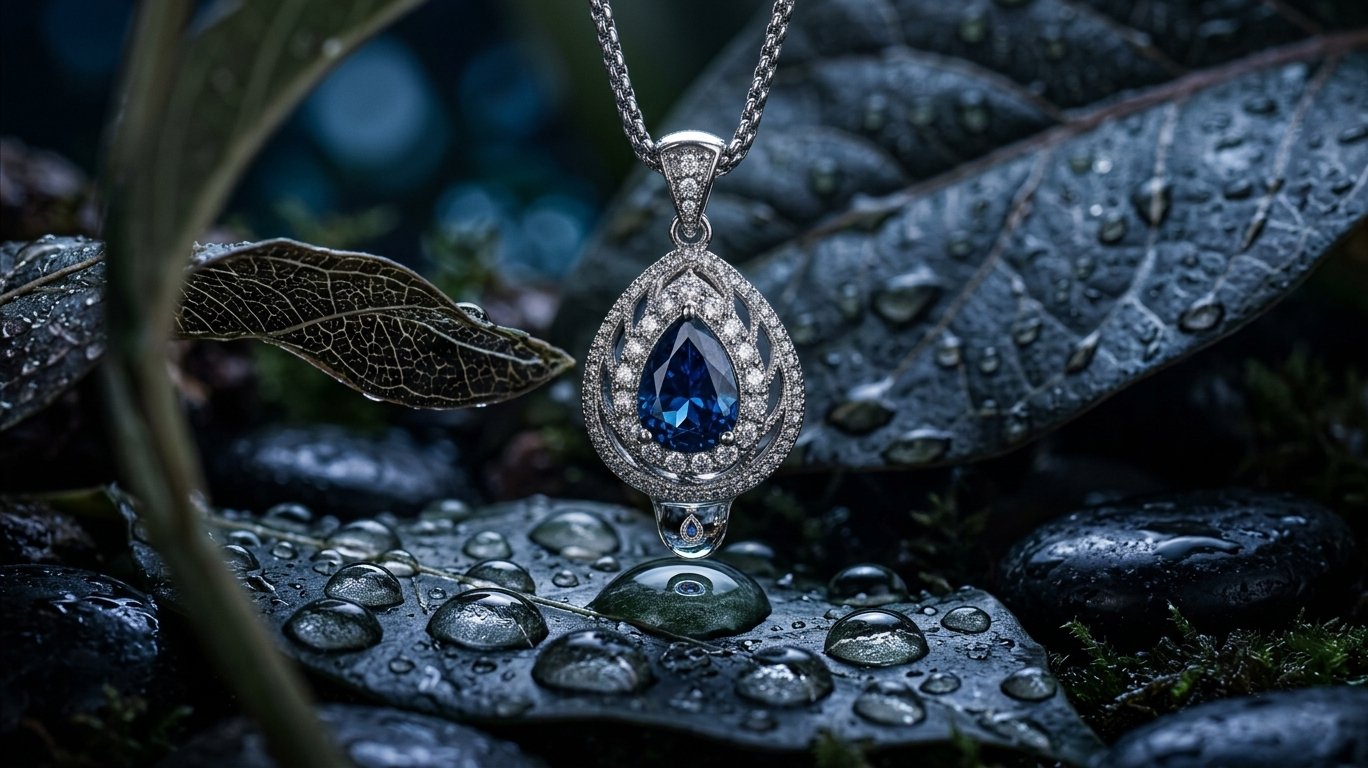
A deep blue sapphire can feel completely different from a vivid ruby.
An emerald can feel completely different from a black gemstone.
A pink stone can remind someone of their mother.
A green stone might remind somebody of a place they grew up.
A particular gemstone might have a cultural or spiritual meaning that has been passed down through their family.
And sometimes somebody just likes purple.
That’s allowed.
Not every decision needs a mystical explanation.
But when a person does have a personal or spiritual connection to a particular stone, we want to understand that.
Not tell them what the stone is supposed to make them feel.
Understand what they already feel.
That’s a major difference.
We don’t believe a gemstone has to magically change you
This is important.
There are traditions around the world that attribute healing, protective or energetic properties to particular stones and metals.
Those beliefs are part of human culture and spirituality.
But we aren’t going to pretend that every one of those claims has been scientifically proven.
What we do believe is something a little more human.
Symbols affect people.
Memory affects people.
Ritual affects people.
Meaning affects people.
If somebody wears a ring every day because it represents the person they love, the emotional effect of that object can be very real.
Not because the metal has supernatural powers.
Because the person has given the object meaning.
And that meaning can become incredibly powerful.
Jewellery becomes a physical memory
This is probably the part that matters most.
A ring isn’t a marriage.
But it can remind you of one.
A necklace isn’t your mother.
But you can wear it because she gave it to you.
A bracelet isn’t your achievement.
But you can look at it and remember what you went through to get there.
A stone isn’t a relationship.
But it can become attached to the memory of one.
The human brain does this constantly.
We attach memories to places.
Music.
Smells.
Photographs.
Objects.
And jewellery has one huge advantage over most of those things.
You can wear it.
It’s physically with you.
Every day.
That’s powerful.
This is why our custom process starts with the person
When someone comes to Soulmate Sparkles, we don’t want to start with:
What’s your budget?
We eventually need to know that.
Obviously.
A custom piece has a real manufacturing cost and we need to design within someone’s financial reality.
But before we decide what metal goes around the stone, we want to understand the person.
What’s happening in your life?
Why are you making this piece?
Who is it for?
What are you trying to say?
What do you want to remember?
What do you want this piece to represent five years from now?
Ten years?
Twenty?
Because then the material choices become much more interesting.
Maybe it’s 9K gold.
Maybe it’s 18K.
Maybe it’s platinum.
Maybe it’s sterling silver.
Maybe it’s stainless steel.
Maybe it’s a lab-grown diamond.
Maybe it’s moissanite.
Maybe it’s a sapphire.
Maybe it’s a ruby.
Maybe it’s something completely different.
We aren’t trying to force everybody into the same idea of luxury.
We’re trying to translate a person into an object.
That’s what custom jewellery actually means to us
Custom doesn’t just mean:
Pick your metal.
Pick your stone.
Pick your setting.
Pay the invoice.
That’s personalisation.
There’s a difference.
True custom jewellery should start with the story.
Then the design.
Then the material.
Then the craftsmanship.
And finally, the object.
Because if we start with the material, we’re essentially asking:
What can this stone or metal sell for?
If we start with the person, we’re asking:
What could this object mean?
That is a much more interesting question.
You might have enough money for platinum and still choose silver
And that’s completely fine.
You might have the money for a huge natural diamond and still choose a laboratory-grown one.
You might have enough for a diamond and choose moissanite.
You might be able to buy gold and choose stainless steel.
Not because you can’t afford something else.
Because the piece isn’t supposed to prove how much money you have.
It’s supposed to mean something to you.
That’s the distinction we’re trying to protect.
The future of jewellery doesn’t have to look like the past
For thousands of years, humans have taken materials from the world and turned them into symbols.
That’s not going to stop.
But our understanding of the world is changing.
We understand more about geology.
We understand more about materials.
We understand more about mining.
We understand more about global supply chains.
We have technologies our ancestors couldn’t even imagine.
We can grow diamonds.
We can design jewellery digitally.
We can sculpt an idea in CAD before a physical piece exists.
We can create incredibly precise custom forms.
We can combine traditional craftsmanship with modern manufacturing.
So why should our definition of luxury stay stuck in the past?
Why should something only be considered meaningful because it was extracted from somewhere?
Why can’t innovation be part of luxury?
Why can’t responsibility be part of luxury?
Why can’t thoughtfulness be part of luxury?
Why can’t the story behind the piece be just as important as the material?
From a shell on the South African coast to a ring on your finger
This is the part that brings everything together for me.
Some of the earliest evidence we have of humans wearing jewellery comes from Africa.
People who lived tens of thousands of years ago took something ordinary from the natural world and made it meaningful. The shell itself wasn’t the point anymore.
The meaning was.
Today, we’re doing something remarkably similar.
We’re just using different tools.
Instead of drilling a shell, we might design a ring in CAD.
Instead of tying shells together, we might create a platinum setting.
Instead of a piece of ochre-stained shell, we might use a coloured gemstone.
Instead of a naturally occurring diamond, we might choose a laboratory-grown one.
The technology is different.
The human instinct isn’t.
We still want to take something physical and make it carry something invisible.
Love.
Memory.
Identity.
Achievement.
Grief.
Hope.
Commitment.
A new beginning.
A promise.
Something we don’t necessarily know how to explain.
So we put it on our bodies.
And we carry it.
Soulmate Sparkles isn’t trying to sell you a more expensive feeling
That’s really what this comes down to.
We don’t believe a more expensive metal creates a deeper love.
We don’t believe a bigger stone automatically means a bigger commitment.
We don’t believe someone needs a natural diamond to prove that their relationship is real.
And we definitely don’t believe someone should have to ignore the human cost or wider consequences of a material just because the industry has taught us that “natural” automatically means “better.”
We want to know what matters to you.
Then we want to build around that.
Because maybe your story belongs in gold.
Maybe it belongs in platinum.
Maybe silver.
Maybe stainless steel.
Maybe it belongs in a lab-grown diamond.
Maybe moissanite.
Maybe a sapphire that carries a colour you’ve loved your entire life.
Maybe something we’ve never made before.
That’s the beauty of custom.
There isn’t supposed to be one answer.
Jewellery has never really been about the object
The shell wasn’t the point.
The gold wasn’t the point.
The diamond wasn’t the point.
The gemstone wasn’t the point.
The metal was never the whole story.
Humans have always been trying to put something invisible into something physical.
That’s what we’ve been doing for thousands of years.
And that’s what we’re still doing now.
The difference is that today, we have more choices.
More materials.
More technology.
More knowledge.
And, hopefully, more responsibility.
At Soulmate Sparkles, that’s what we want to do with those choices.
Not make jewellery that simply looks expensive.
Make jewellery that means something.
Jewellery that reflects where you’ve been.
Where you are.
Where you’re going.
What you love.
What you’ve survived.
What you believe.
And what you want to carry with you.
Because when you really think about it, that’s what jewellery has always been.
A physical reminder of something that can’t be seen.
And maybe that’s why, after more than a hundred thousand years, we’re still wearing it.
Not because humans suddenly became obsessed with luxury.
Because humans have always needed a way to carry their meaning with them.